Showing posts with label science fiction. Show all posts

Saturday, 6 August 2011

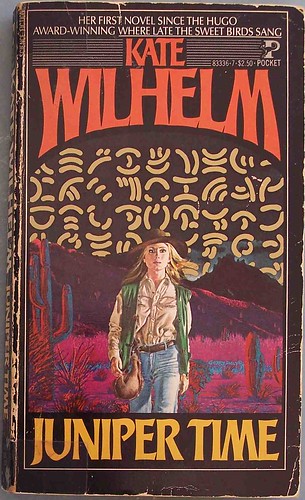
JUNIPER TIME BY KATE WILHELM

Mostly very good, even if, purely as extrapolation, a lot of plot elements haven't held up. A very canny and thoughtful derailment of a carefully built-up first contact motif set against a near future world where international conflict and ecological crisis prevail.

Where the novel failed for me, right at the eleventh hour, was in the excessively expository manner in which the conflicts and resolutions of the last 20 pages are played out, all tell and no show. Wilhelm has points to make about human motivation, the dehumanising nature of obsession, our pathetic management of the environment, our addiction to one-upmanship and our counter-productive attachment to seeing things as binaries. She also creates at least one fascinating central character; but he is not sympathetic, and one sympathetic character; but she is too good to be true. The rest of the characters are like stock figures in a passion play. Despite which there is some very beautiful writing that displays an admirable sense of place and grasp of metaphor.

A wise book, but not enough of a novel. By way of contrast, see Ursula Le Guin's The Lathe Of Heaven, which exemplifies why John Clute describes Le Guin as a 'wise teller of tales'.

Friday, 28 January 2011

The Player Of Games by Iain M. Banks

I've finished re-reading Iain M. Banks' The Player Of Games. I thought Banks showed a growing mastery of style in this novel, unlike Consider Phlebas where several sentences in a row were sometimes clotted with clauses and fly-specked with commas. The style is considerably more fluid here and the lyrical streak in Banks's prose is allowed more free rein in describing the various strange settings Jernau Gurgeh, the player of games, moves through as well as the mental states associated with his immersion in his game-playing.

Gurgeh is a master gamer, sent by Special Circumstances, the Culture's espionage wing, to the empire of Azad. Power in Azad is won as the result of an individual's peformance in the great game that gives the empire its name. I wonder if there's a nod here to the 'Great Game' between the British and Russian empires for control of central Asia in the 19th century. Banks' depiction of the empire of Azad is obviously a critique of  imperialism and it goes beyond simple outrage to portray a society that is built on identifying and destroying innocence at every level. I can't help but read a similar critique of western foreign policy into the Culture's unwillingness to overtly enter into hostlities against a regime that is opposed to everything it stands for, out of deference to the common people of Azad, who would wind up being conscripted against their would-be liberators rather than uniting against their imperial oppressors in such a scenario.

The game of Azad is not shown in any detail; there is no way you can even approximate a description of its rules from the hints Banks lets out. Instead, Banks focuses on the mental rigours and insights Gurgeh has to experience to master the game. Again, this is a fascinating process because of the reactions of Gurgeh, a citizen of a loosely organised, anarchistic society to a rigidly structured and hierarchical society. At some level, Azad is not that different from any of our societies, a point that hits home when we see an Azad city through Gurgeh's eyes, with its  crowds, traffic, chaos, sharp divides between privilege and poverty and its architectural patchwork.

The suspense grows to a fever pitch, and it soon becomes clear that Gurgeh is playing for higher stakes than simply to make a decent showing in the game of Azad and help boost the Culture's prestige. There's a memorable final act which works on both the surface level of the story and as a summation of the political and social ideas Banks is playing around with. Banks' mechanical characters continue to be more appealing and engaging than his humans, but otherwise, this is a satisfying novel, thought provoking, exciting and as good on my second read as I recall it being the first time around.

PS: The gender business, while fascinating to me the first time around, does not play a very significant role in anything. Banks' points about the differing role of gender in the egalitarian, sex-changing Culture and Azad could as well have been made with normal number of genders. It would also work better if I felt Banks actually had any intention of engaging with gender in any serious way, which a number of things in this novel and its predecessor argue against. Still, it's a nice little touch of SFnal strangeness.

Tuesday, 25 January 2011

Consider Phlebas by Iain M. Banks

For a long time, I admired Iain Banks from afar. I read his second SF novel, The Player Of Games, and I was blown away. It was different from the kind of SF I was familiar with (mostly Asimov and Clarke), somehow more baroque and kickass. I also read his non-SF debut, The Wasp Factory and was once again impressed. Then came a long period of time when I couldn't spend much on books, his books appeared in stores in India only sporadically and, knowing that the Culture books were a series, I thought I couldn't buy a random installment without having the previous ones. All that has been remedied now that I found a full set of his Sf novels (upto Matter) in a second-hand bookstore, and I finally get the chance to read Banks's SF novels in sequence.

So, Consider Phlebas. The Elliot quote suggests a certain ambition beyond the standard space opera, and the novel often delivers on it, incorporating themes of transformation, decay and death that echo The Waste Land. It's also a gripping space opera, following a rather unsavoury, ruthless protagonist on a quest for a MacGuffin. There are amazing set-pieces, like a game of chance on a world that is slated for destruction, vivid descriptions of fantastic worlds and places and some effective renderings of weird or non-human states of mind.

There's a complex plot that makes you think against the warp of the typical space opera, in so far as, if you think the arguments through, the protagonist's enemies emerge as the better side in this war. There are moments when the narrative seems to flounder under a sometimes over-dense style, but the last three chapters are a harrowing race to destruction that left me somewhat shattered.

I still don't know why anyone should care for the protagonist, least of all the two people who come to during the course of this novel. He's ruthless, murderous and completely self-seeking, willing to kill, lie and bide his time with one lover while trying to work his way back to a former lover and basically destroy anyone or anything to achieve his ends. At least he has the strength of his fanatical opposition to the Culture, an opposition that seems increasingly flawed and baseless as more is learned about his nature.

I also expect this to be something of a prelude; while there was much that I enjoyed abut this novel, not least its unflinching depiction of he consequences of religious fanaticism, this story feels something of a footnote. I'm certainly looking forward to my next Banks novel - a re-read of The Player Of Games!

Monday, 6 December 2010

There Will Be Skulls

Wow.

I've always known Silverberg is one of the Great Old Ones. A cornerstone of the genre, author of books like Nightwings, Thorns and Dying Inside that are classics in  the genre, and would be classics outside the genre as well if the consensus cogs would get their heads out from up the bums of D. DeLillo, I. McEwan and so forth for long enough to notice. But it's one thing to admit a writer into your personal canon and and quite another to be reminded, knee to the groin, uppercut to the jaw, nose leaking blood, head pinned down in the sand, that here, make no mistakes, is the real thing - a champion brawler, and he's not pulling his punches.

The Book Of Skulls is a yarn about four young men on a quest for immortality. It's a playing out of a cunningly crafted problem in human nature - given that only two out of four will win, that one must kill himself and one must be killed with the consent of the others, who will crack, who will triumph, and why?

It's a quadruple character study as we weave in between four first-person narratives, each one not perfectly reliable, each one rendered with perfect pitch. A virtuoso performance, but that's not all. Why are these four young men on this quest? Which of their motivations has what it takes to survive all the hardships and doubts on the way? What makes a person strong or weak? Silverberg unfolds answers to these questions with a feel for plot, language and character that is frankly awe-inspiring.

He also scores one for the genre in general.This story could not have been so profound and so real if it was just another 70s yarn about college boys from different backgrounds roadtripping across the US of A. It's the fantastic element that throws everything into perspective, that lets Silverberg give his story the momentum, presence and the power to say something about the everyday human concerns that underpin it. They say speculative fiction is about thought experiments and this is a thought experiment in human nature, conceived and carried out by a behemoth talent.
Monday, 25 October 2010

The Dancers At The End Of Time: Michael Moorcock

(Illustration: Aubrey Beardsley, The Scarlet Pastorale)

I'm currently re-reading these novels (in the handy SF Masterworks omnibus edition) and am again discovering just what a fine writer Moorcock at his best is. His swords-and-sorcery, with the exception of Elric, has always been a little hit-and-miss for me, but it's his so-called literary fiction and his non-traditional fantasy that impress me the most. Along with the freaked-out Jerry Cornelius novels, this trilogy stands among his most original, subversive, satirical and flat-out fantastic work.

It's Moorcock's on take on a dying earth milieu, filtered through a Decadent lens. The immortal and nearly omnipotent denizens of the end of time vie with each other in coming out with ever more elaborate fads, crazes and parties, recreating past epochs in various highly anachronistic ways and indulging in every pleasure - and pain - known to living beings. One of them, Jherek Carnelian, decides to try and revive the ancient mysteries of 'virtue' only to be diverted into another archaic spasm, 'love' by the arrival of a time traveller from the 19th century.

The sheer fertility of Moorcock's imagination, the vividness of his descriptions, the variety and sting of his satirical barbs and the sparkling dialogue indulged in by his endtime decadents all make these books an absolute delight. I suspect they'd leave readers expecting some sort of epic fantasy or SF a little nonplussed, but for the reader with no expectations except brilliance, these books may just be the ticket.
Widget_logo