Weird fiction's primal duty is to fuck [alternative word: debauch] your brain and kiss your sense of wonder.
- W.H. Pugmire
Sunday, 14 August 2011

Wednesday, 10 August 2011
'Where is the writer,' he began, 'who is unstained by any habits of the human, who would be the ideal of everything alien to living, and whose own eccentricity, in its darkest phase, would turn in on itself to form increasingly more complex patterns of strangeness? Where is the writer who has remained his entire life in some remote dream that he inhabited from his day of birth, if not long before?'
- Thomas Ligotti, 'The Journal Of J.P. Drapeau '
Tuesday, 9 August 2011
a political tout
China Mieville, responding to a reader who asked if he would ever be willing to write something that did not 'tout' his 'Liberal politics':
From this thread on goodreads: http://www.goodreads.com/topic/show/566606-ask-china-mi-ville?format=html&page=1
The way I see the world is, among other things but very importantly, a political one, and I write fiction from where I see the world. Therefore, it’s no surprise that the concerns, interests, textures and tractions that inform the fiction are, to various degrees recognizably, related to my politics. Just as they are with many other writers, of all kinds of varying positions, for whom politics are important.
So when you ask if I’m ‘willing to write anything that doesn’t tout’ my own position, how I have to interpret that is ‘Are you willing to write a book that is not written from a position of seeing the world the way you see the world?’ To which, the answer, of course, has to be No. How could I possibly do so? I don’t want to do so, either, even if I could, which I cannot. The things you say you like in the books come from the same place of which the politics are an inextricable component. I don’t say they’re coterminous – but they are inextricable in my head, and I don’t want to extricate them.
From this thread on goodreads: http://www.goodreads.com/topic/show/566606-ask-china-mi-ville?format=html&page=1
Saturday, 6 August 2011
JUNIPER TIME BY KATE WILHELM
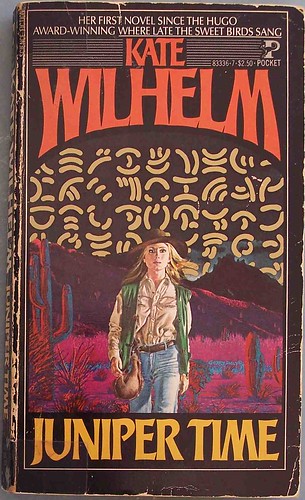
Where the novel failed for me, right at the eleventh hour, was in the excessively expository manner in which the conflicts and resolutions of the last 20 pages are played out, all tell and no show. Wilhelm has points to make about human motivation, the dehumanising nature of obsession, our pathetic management of the environment, our addiction to one-upmanship and our counter-productive attachment to seeing things as binaries. She also creates at least one fascinating central character; but he is not sympathetic, and one sympathetic character; but she is too good to be true. The rest of the characters are like stock figures in a passion play. Despite which there is some very beautiful writing that displays an admirable sense of place and grasp of metaphor.
A wise book, but not enough of a novel. By way of contrast, see Ursula Le Guin's The Lathe Of Heaven, which exemplifies why John Clute describes Le Guin as a 'wise teller of tales'.
Friday, 5 August 2011
THE SKULL OF TRUTH BY BRUCE COVILLE

Bruce Coville is a prolific American writer of fiction for children whom I first discovered in my 20s, with the 'My Teacher Is An Alien' books. I was impressed by how real and believable his characters are, children, grown-ups and aliens and how well his imagination conjures up situations and settings that invoke a sense of wonder. I also noted how he handles larger messages and themes in a way that's not preachy or intrusive and is alive to the many sides of any given issue. Most of all, I was taken by Coville's obvious joy in the art of storytelling.
In this book, Coville tackles one of the big issues any fictioneer has to grapple with at some point: truth. When Charles Egglestone stumbles into a mysterious shop and winds up shoplifting a talking skull, he finds that the skull's magical powers have made it impossible for him to lie anymore. At first, disaster follows, because the truth is not always the convenient or even the right thing to blurt out. Gradually, he gains a deeper, richer sense of what truth is all about, how it can be found both in fact and fiction and how it can be used for good, although it is in itself morally neutral. I was particularly glad that Coville keeps that last point very clearly in sight. Truthfulness isn't a magic key to virtue - it's still up to us to keep our eyes open and work out the ethics of everything we do. I can think of vast tomes written for a putatively grown-up audience that miss this point.
That exposition of the book's themes probably sounds dry. But this book isn't. It's hilarious, poignant and inventive, and manages to invoke a character from Big Bill Shakespeare's plays - see if you can guess which one - and give him a back- and front-story, if I can put it that way, which is as resonant and memorable as anything from the Bard's plays. I get a real kick out of a piece of fiction that can engage with one of the classics and emerge enriched rather than simply bested by the experience, and the former is certainly the case here. (Neil Gaiman has done this sort of thing well at points in his career - Sandman for instance - and not so well at other points - the Beowulf film). If I had a child between the ages of 7 and 11 at my disposal, I would entreat him or her to read this book. But since I don't, I'm just as happy to have had the chance to read it myself.
Saturday, 30 July 2011
Wednesday, 27 July 2011
blocked
story wavers
words shimmer
i reach but cannot grip
sense remains
sense prevails
i give up
words go back in single file
along the bleak marches
all the way back into
that dark country
of the unimagined
words shimmer
i reach but cannot grip
sense remains
sense prevails
i give up
words go back in single file
along the bleak marches
all the way back into
that dark country
of the unimagined
Subscribe to:
Posts (Atom)
